
A big reason people say they voted for Donald Trump is because of his alleged business expertise. He claimed to be a successful businessman, after all. He flew around the world on private jets and had buildings named after him. A majority of the electorate believed the U.S. economy could use someone like him to give it a needed push.
That turned out to be one of his many cons.
Fast-forward 19 months, and many sectors of the economy are worse now than before Trump returned to the Oval Office. While not all of the blame is his, much of it is.
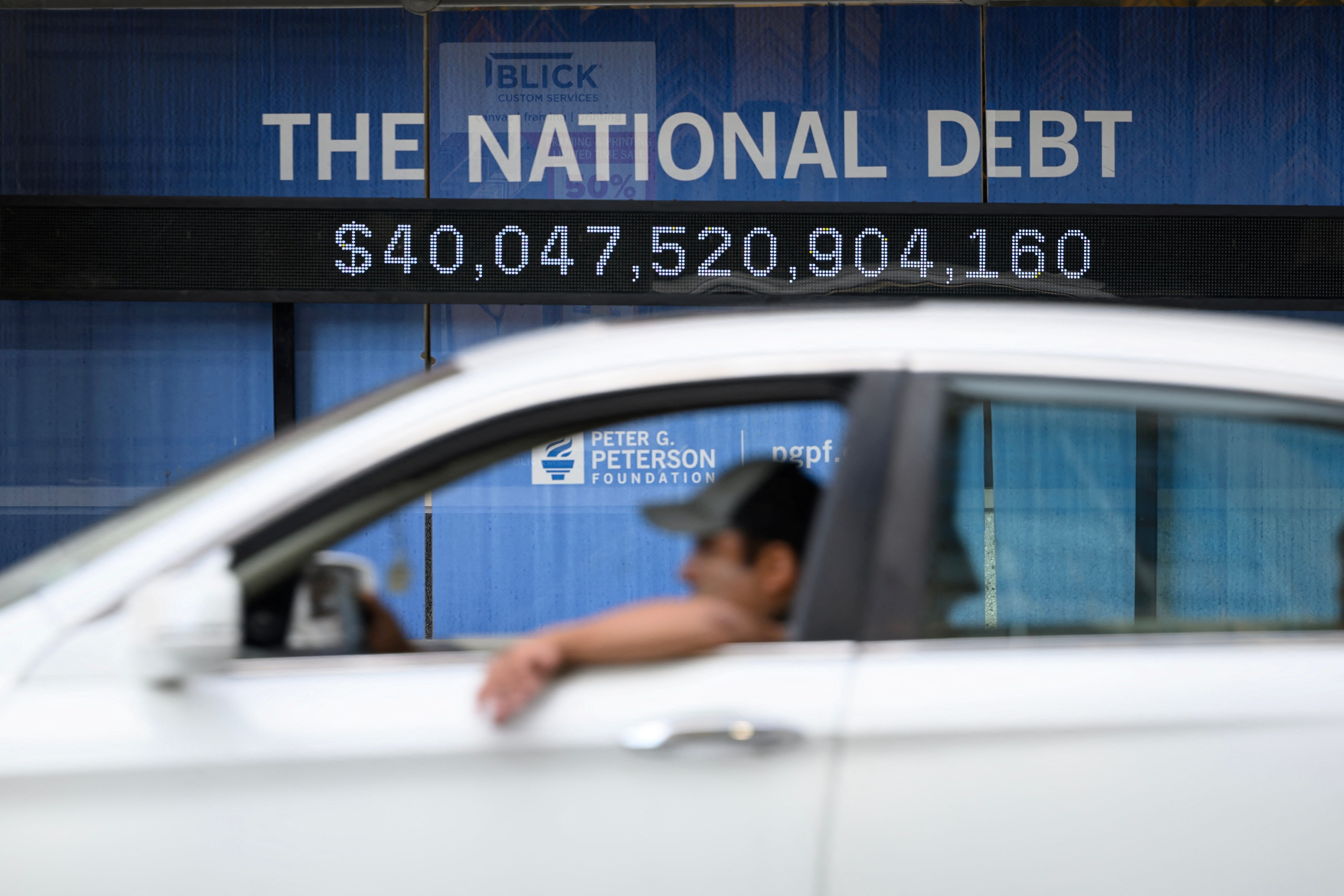
This week brought a big fiscal shocker. The United States economy hit a milestone. Not a break-out-the-champagne achievement, more of let’s-have-leftovers-for-dinner benchmark. The U.S. debt surpassed $40 trillion.
Forty trillion is an enormous number. One trillion has 12 zeros. One trillion seconds equals about 31,700 years. In comparison, one million seconds is about 11 days; a billion seconds is just under 32 years.
Think about this — even if Elon Musk, the world’s richest man, used all of his wealth to pay down the U.S. debt, it would still be more than $39 trillion.
While the U.S. debt crossing the $40 trillion threshold is largely symbolic, it is — to say the least — not good. It’s not likely to cause immediate, massive repercussions. It is, however, a damning symbol that things have gone from bad to worse much faster than predicted — a red-light warning about the future.
How will it affect you? Don’t expect home mortgage rates or auto loan rates to drop. The American standard of living will likely be lower too. Democrats share some of the blame, as does an aging population that is entitled to expensive social programs, but much of it is because Trump has been president for two terms.
Let’s pause for some Economics 101 here. We’ll make it as brief and cogent as we can. But it is imperative that we all understand the significance of the debt and how it affects every American.
The Deficit
Before we can get to the debt, we have to understand the deficit. It is the difference between how much someone — or in this case a government — spends versus how much they take in. If a person makes $1,000 a week and rent, food, car payments, and gas cost $1,100, they have a deficit of $100. The same goes for the government, but on a much larger scale.
The Debt
Over time, deficits accumulate. That running total is debt. To pay off debt, a person might borrow money or use a credit card, which is essentially the same thing. The cost of borrowing money is interest. The government does the same thing, though it borrows money in the form of Treasury bonds or T-Notes.
The government must pay interest on those T-Notes to pay its $40 trillion debt. That costs taxpayers $1.1 trillion a year. That is more than the current defense budget and is the second-largest budget line item behind Social Security.
Revenues
The aforementioned person taking in $1,000 a week usually does so by working. If he or she wants to make more money to close the gap between income and expenses, they might apply for a higher-paying job or undergo additional training. The government’s income is based overwhelmingly on taxes. If it needs more money, its options are to increase taxes, borrow, or just print money.
Raising taxes is generally an unpopular move, while the converse, cutting taxes, is very popular. And therein lies the core of the U.S. debt problem.
Since the 1960s, government spending has spiraled upward while revenue in the form of taxes has remained stagnant. During the Eisenhower administration, the richest Americans paid an effective tax rate (after deductions and loopholes) of 50-56%. Today, the 400 wealthiest Americans pay just 24% in income taxes, according to the National Bureau of Economic Research.
In recent years, billionaires like Jeff Bezos and Donald Trump have paid no income taxes. Neither have some of the most profitable American companies like Tesla and United Airlines.
Becoming the world’s biggest debtor (China is second at $18.7 trillion) didn’t happen overnight. While the debt has grown under every modern president, much of the speed with which we reached $40 trillion has been because of Trump. It took the U.S. 192 years, from 1789 to 1981, to accumulate a debt of $1 trillion. In the ensuing 45 years, it added $38 trillion. The most recent trillion took just five months.
Trump added $7.8 trillion to the debt in his first term. So far during his second term, he has added $3.8 trillion. His damaging economic policies have brought us to this moment months sooner than predicted. Economists knew the U.S. would surpass $40 trillion in debt, but most thought it wouldn’t happen until next year. Much of the acceleration of the debt crisis has been caused by Trump’s tariffs, his massive tax cuts for billionaires, and war in Iran.
Though many experts told him otherwise, Trump believed his tariffs would net the U.S. Treasury $160 billion. Not only did that not happen, but the Supreme Court ruled his tariffs illegal and the money they generated now must be refunded.
Elon Musk and his “Department of Government Efficiency” promised to cut $1 trillion in government waste. Virtually no money has been saved, but the cuts have caused irreparable harm to almost every federal agency, and 300,000 people lost their jobs.
Trump’s “One Big Beautiful Bill Act,” which cut Medicaid and food assistance for the most vulnerable Americans, also gave $3 to 4 trillion in tax cuts to the richest Americans. Trump’s profligate spending and penchant for handing out tax cuts to his friends make a joke of fiscal responsibility.
“Our current fiscal trajectory is plainly unsustainable, and that’s the best-case scenario. AI disruption, a recession, global war, or any number of other events could quickly push us over the edge from a challenge into a full-blown crisis. Even in the rosiest scenarios, we’re speeding toward a cliff and refusing to turn the wheel,” Bipartisan Policy Center president and CEO Margaret Spellings said in a statement.
The $1.1 trillion the government is now spending to service the debt is money not being spent on public services like health care, infrastructure, or improving public schools. It also means we will all pay more to borrow money for everything from cars to homes to tuition.
You may remember back in 2016 when Trump proclaimed himself the “king of debt,” promising to eliminate it in eight years. Forty trillion dollars later, that was just another grift. Meanwhile, he is treating the U.S. Treasury like his own personal piggy bank, gleefully spending close to a billion dollars in taxpayer dollars to glorify himself with gilded pieces of junk, mega-ballrooms, and monuments for which no one asked.
You can support my team’s efforts to protect our democracy through the power of independent journalism by becoming a paid subscriber. It’s one of the best deals on Substack. I thank you for your consideration.
No matter how you subscribe, I thank you for reading.
Stay Steady,
Dan
It’s amazing to think that we once had a balanced budget in the 1990s (under Clinton), less than 30 years ago.
I haven't even read Dan's post, but the headline says it all when it comes to any enterprise Trump gets involved in: It's never, ever his money. It's always someone else's and he often leaves others on the hook for that money since many of his ventures failed. Those are micro examples of the macro problem this man has caused our country as its president. How COULD people NOT SEE this coming! How could anyone with a brain not see he is not and has never been a "financial genius"?